
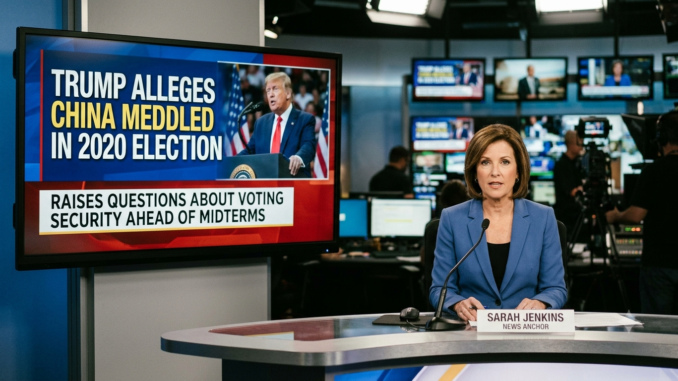
Election cycles in the United States often bring intense focus to the mechanics of voting. Former President Donald Trump has reignited this conversation by asserting that China meddled in the 2020 election while raising new questions about voting security ahead of the midterms. These claims are important because they impact how many Americans view the legitimacy of their democratic institutions. Understanding the nature of these allegations and the current state of election infrastructure helps clarify the debate surrounding American voting integrity.
Trump Alleges China Meddled in 2020 Election
The claims made by Donald Trump regarding the 2020 presidential race focus on external threats to the electoral process. By pointing to China as a potential actor, the former president has kept the topic of election security at the center of political discussion.
The Specifics of the Alleged Actions
When discussing these allegations, the former president often refers to a few key areas. He has suggested that foreign influence could have targeted voting machines, manipulated voter registration databases, or spread disinformation to change voter behavior. While these types of threats are real concerns for cybersecurity experts, the core of the debate lies in whether they impacted the outcome of the 2020 vote.
Specific evidence linking these alleged actions directly to a change in vote tallies has not been presented in court or through official government investigations. Instead, supporters often point to broad reports of foreign interest in U.S. politics to support their concerns. These claims often blur the line between attempts to influence public opinion—which foreign entities do—and the successful manipulation of actual ballots.
Timing and Motivation
The resurgence of these claims is closely tied to the approach of the midterm elections. By keeping concerns about 2020 in the public eye, figures like Trump aim to keep their base focused on election integrity. This strategy serves several purposes. It helps to keep the 2020 result as a point of contention rather than a settled matter. Furthermore, it places intense pressure on local and state election officials to demonstrate the security of their current processes.
Examining the Security of the 2020 Election Systems
To understand the validity of concerns, it is necessary to look at what official sources found after the 2020 vote. Multiple levels of government reviewed the integrity of the process to ensure results were accurate.
Assessments from Federal Agencies
The U.S. intelligence community and various federal agencies monitored the 2020 election for foreign threats. Their consensus report after the election noted that while foreign actors, including China and Russia, held interests in the election outcome, there was no evidence that they altered or deleted any votes. These agencies focused on the difference between influence operations, like social media campaigns, and actual interference in the technical casting or counting of ballots.
Results from State and Local Audits
States across the country conducted post-election reviews, including machine audits and hand counts. For instance, in key battleground states, election officials performed deep, bipartisan reviews of voting systems. These processes included verifying the paper trail, testing machines for unauthorized software, and checking vote counts against poll books. These audits consistently reaffirmed the initial results. While some discrepancies were found, they were typically due to human error, such as misplaced ballots or minor clerical mistakes, rather than coordinated fraud or foreign hacking.
Current Voting Security Measures Ahead of Midterms
Since 2020, states and counties have focused on bolstering security for future elections. The goal is to build a system that is both resistant to interference and transparent to the public.
Technology and Physical Upgrades
Many jurisdictions have replaced older voting machines with updated models that provide a paper record for every vote cast. This is a significant security improvement because a physical ballot is difficult to alter electronically. Additionally, election officials have increased the physical security of ballot drop boxes and ballot storage areas. Improved chain-of-custody procedures ensure that every ballot is accounted for from the moment it is cast until it is counted.
The Role of Election Officials
The people who run elections are the first line of defense. Training programs for poll workers now focus heavily on identifying potential threats, managing secure data, and handling ballots properly. These workers are trained to spot irregularities in voter check-in processes and to follow strict protocols to protect the machines. Their preparation is a critical component of ensuring that the voting experience is both smooth and secure for every citizen.
Public Perception and Trust in Election Integrity
Allegations of interference, whether proven or not, have a lasting effect on public trust. When a prominent figure questions the security of an election, a segment of the population may lose faith in the process regardless of what official audits show.
Data on Voter Concerns
Polling data consistently shows that a significant number of Americans remain skeptical of election security. This skepticism is often divided along partisan lines, showing that the narrative surrounding the 2020 election continues to influence current political attitudes. The challenge for election officials is to communicate the reality of their security measures to an audience that may already be inclined to doubt the results.
The Challenge of Misinformation
Misinformation and disinformation campaigns make it difficult for voters to distinguish between verified threats and unsubstantiated claims. When false information about voting machines or ballot counting spreads online, it creates confusion. Election offices are now more active in using social media and official websites to correct false claims quickly. They are working to provide clear, accessible information about how the process works and how it is secured.
Future of Election Security
Election security is not a single point to be reached but a process that must continue to adapt. The threats to democracy change over time, requiring constant evaluation and improvement.
Balancing Security and Accessibility
A primary challenge is ensuring that security measures do not create barriers for eligible voters. Requiring identification or limiting voting hours can increase security, but these actions can also make it harder for some people to participate. The most effective systems find a balance that makes it easy for every citizen to cast a ballot while making it very difficult for anyone to commit fraud. This requires thoughtful policy that considers both the integrity of the vote and the principle of universal suffrage.
The Value of Bipartisan Cooperation
Public trust depends on the sense that the election process belongs to everyone, not just one party. When politicians from both sides of the aisle work together to improve security, it builds confidence among all voters. Bipartisan audits and election oversight committees are examples of this cooperation. These efforts signal to the public that the process is being managed fairly and that all sides have a stake in the outcome.
Continuous Improvement
The threat of foreign influence and technical vulnerabilities means that the work of securing elections never stops. New technologies require new defenses. This involves ongoing investment in election infrastructure, constant testing of voting systems for weaknesses, and continued training for the staff responsible for running polling places. By focusing on technical accuracy and transparent procedures, the electoral system can remain the foundation of American democracy.
Leave a Reply